

My Favorite Things to do in Aix en Provence France!


Aix en Provence hit differently than any other place I visited in southern France.
I expected cobblestone streets and cute cafés. What I got was a full sensory reset. The scent of fresh produce at dawn markets, the sound of water fountains echoing through narrow alleys, the taste of local specialties that made me rethink everything I thought I knew about French food. This isn't a city you check off a list. It's a place you feel in real time.
I spent time walking every corner of the historical centre, getting lost in the Mazarin district, and chasing light across Montagne Sainte-Victoire. Some days I had a plan. Most days, Aix rewrote it for me. This is a list of my favorite things to do in Aix en Provence.
Here's everything that made me fall hard for this town.
Things to do in Aix en Provence:

ICONIC STREETS AND HISTORIC QUARTERS
The heart of Aix pulses through its oldest streets. The Mazarin quarter and old town aren't just backdrops for photos. They're living archives of 17th century architecture, everyday life, and the kind of beauty that stops you mid-step. These areas gave me the most shareable moments of my entire road trip through Provence-Alpes-Côte d'Azur.
Cours Mirabeau
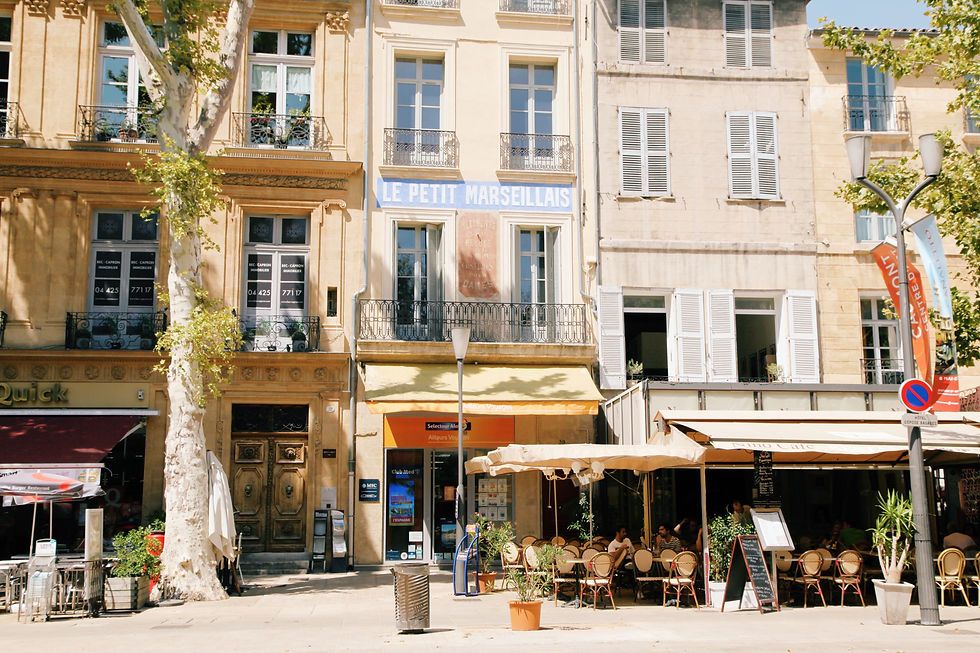
Cours Mirabeau is the postcard everyone sends, but no photo does it justice. This tree-lined avenue splits the city centre in half, shaded by plane trees so thick that even midday sun barely touches the cobblestones. On one side, outdoor cafés buzz with locals sipping espresso at their own pace. On the other, 17th century mansions stand like they own the whole year.
What works here: Grab a seat at Les Deux Garçons around 9 a.m. before the tour groups arrive. Order an espresso, claim a table, and just watch. You'll see students heading to class, market vendors passing through, and older couples reading the paper like time doesn't exist. The rhythm is contagious.
Golden hour transforms this street. Come back between 6 and 7 p.m. The western light filters through the trees and every fountain along the avenue glows. If you want that one shot that makes people ask where you've been, this is the time of day to get it.
The fountain at the top end, Fontaine de la Rotonde, marks the gateway into the historical centre. It's massive, loud, and somehow still elegant. I passed it every single day and it never felt repetitive.
This street isn't a destination you tick off in 10 minutes. It's where you start, reset, and return.
Mazarin Quarter
The Mazarin quarter sits south of Cours Mirabeau and feels like a different era. Built in the 17th century as a planned district, the streets here are wider, the mansions grander, and the vibe quieter than the old town. I'd walk here in the late afternoon when the crowds thinned and the light hit the stone just right.
Place des Quatre Dauphins sits at the center. Four dolphins spout water into a small circular fountain surrounded by perfectly symmetrical buildings.
Rue Cardinale and Rue Mazarine are lined with art galleries, antique shops, and hidden courtyards you'd miss if you blinked.
The quarter feels residential but polished. You'll see locals carrying baguettes home, not tourists following maps.
This part of the city gave me space to breathe. The Mazarin district doesn't demand your attention. It earns it quietly.
Best way to explore: Walk without a plan. The grid layout makes it impossible to get truly lost, but easy to stumble onto beautiful architecture and narrow alleys that dead-end into private gardens.
I found some of my favorite doors here. Deep green paint, brass knockers, stone archways that framed glimpses of interior courtyards. If you're into photography or just love slow walks, this quarter delivers.
It's also a stone's throw from some of the best art centres in the city, which made looping back through here after museum visits feel natural.
ART, CULTURE, AND MUSEUMS
Aix en Provence isn't just pretty. It's stacked with world-class art, deep ties to Paul Cézanne, and museums that punch way above what you'd expect from a spa town. I'm not a museum person by default, but these spots pulled me in and kept me there longer than planned.
Musée Granet
Musée Granet sits just off Place Saint-Jean-de-Malte and holds one of the strongest art collections in southern France. The building itself is a former priory, and the interior courtyard alone is worth the visit. Inside, you'll find works by Cézanne, Picasso, and a rotating selection of contemporary art that shifts every few months.
Why it matters: This isn't a stuffy regional museum coasting on local pride. The Granet curates at an international level. I saw pieces I'd only seen in textbooks, hung in rooms with perfect natural light and zero crowds fighting for space.
The Cézanne galleries are the anchor. You'll see his early experiments, his obsession with Montagne Sainte-Victoire, and sketches that show how he thought through composition. If you're planning a full-day trip to his studio or the mountain later, start here. It frames everything.
Admission is affordable and includes access to temporary exhibits
The museum shop sells high-quality prints and books you won't find at tourist traps
Go midweek if you want the galleries mostly to yourself
I spent two hours here on a Wednesday morning and had entire rooms to myself. It's one of those rare spots where you can sit on a bench, stare at a painting, and think without someone bumping your shoulder.
The Granet made me understand why Cézanne never left this region. His work and this landscape are inseparable.
Hôtel de Caumont
Hôtel de Caumont is an 18th century private mansion turned art center. The building sits in the Mazarin quarter and hosts rotating exhibitions, usually focused on major names like Van Gogh, Rembrandt, or contemporary heavyweights. When I visited, they were running a Van Gogh show that included pieces on loan from museums across Europe.
What most people overlook: The mansion itself is the real exhibition. The grand staircase, the painted ceilings, the period furniture scattered through the salons. You're not just looking at art. You're standing inside the everyday life of Provence's old aristocracy.
The café in the garden is a hidden gem. Tucked behind the main building, it's quiet, shaded, and serves excellent coffee. I'd finish touring the galleries, grab an espresso, and sit outside for 30 minutes before heading back into the city centre.
Tickets are timed, so book ahead if you're visiting in summer
Audio guides are included and actually add context instead of just reading wall text
The gift shop curates smarter than most museums
This spot works whether you're an art nerd or just want to see inside a ridiculously beautiful building. Either way, you leave satisfied.
If you're juggling meeting times or coordinating with people back in the United States, the current time zone in Aix is Central European Time. During summer time, that's UTC plus two hours. During winter time, it shifts to UTC plus one hour because of seasonal clock changes. The time difference can mess with your head on the first day, but adjusting happens faster here than in major cities because the pace is slower.

Paul Cézanne's Studio
Atelier Cézanne sits on a hill just north of the old town, about a 15-minute walk from the city centre. This is where Paul Cézanne worked during the last years of his life, and the studio has been preserved exactly as he left it. His easel, his brushes, his coat hanging on a hook.
Why this matters more than you think: Most artist studios feel staged. This one feels lived-in. You see the objects he painted over and over. The skulls, the drapery, the pottery. You start to understand his obsession with getting the same subject right from every angle.
The surrounding area is equally important. Cézanne walked these roads daily, obsessed with capturing the light on Montagne Sainte-Victoire. Standing outside his studio and looking toward the mountain connects his paintings to the real geography in a way no museum can.
Admission is inexpensive and includes a short guided intro
The gift shop sells art supplies if you want to paint your own Provence-inspired work
Combine this with a walk to the Terrain des Peintres for the full Cézanne experience
I'm not an artist, but I left this place wanting to try. That's the power of seeing where someone made their best work.
The walk back into town takes you through residential streets that feel unchanged since Cézanne's time. It's the best way to ease back into the present.
MARKETS, FOOD, AND LOCAL LIFE
The food in Aix isn't just good. It's the kind of good that makes you rethink how you've been eating your whole life. The markets overflow with fresh produce, the bakeries turn out pastries that redefine flaky, and the local specialities hit harder than anything I tasted in larger cities nearby.
Place Richelme Market
Place Richelme hosts a daily farmers market that runs every morning until around 1 p.m. This isn't a tourist market. It's where locals buy vegetables for dinner, cheese for the week, and flowers because why not. I showed up the first time expecting cute photo ops. I left with a bag full of tomatoes, goat cheese, and a baguette I ate on a bench.
What makes this market different: The vendors actually care. They'll let you taste before you buy. They'll tell you when their peaches will be ripe. They'll warn you if the melon isn't ready yet. It's the opposite of transactional.
Go early if you want the best selection. By 10 a.m., the prime produce is gone. I started setting my alarm for 8 a.m. just to be there when the market hit its rhythm. The energy is unmatched.
Bring your own bag. Vendors appreciate it and some won't offer plastic.
Cash is king. Not all stands take cards.
The olive vendor on the north side has the best tapenade I've ever tasted.
I went to this market six days in a row and never got bored. The produce changes, the crowds shift, and there's always someone selling something you didn't know existed.
The square itself sits steps from the town hall and is surrounded by cafés where you can sit and watch the market wind down. That post-market coffee became my favorite daily ritual.
Truffles at Market a variety of cured meat at market wine at market
Calissons d'Aix
Calissons are Aix's signature sweet. They're small, almond-shaped candies made from ground almonds, candied melon, and orange zest, topped with royal icing. They sound simple. They taste like the best decision you'll make all day.
Where to get them: Confiserie du Roy René on Rue Gaston de Saporta is the most famous spot, but their quality justifies the reputation. You can watch them being made in the back, and the shop offers samples before you commit.
Calissons are deeply tied to local history. They've been made in Aix since the 15th century, and the recipe hasn't changed much. Eating one feels like biting into a piece of the city's identity.
Buy a small box first. They're rich and a little goes a long way.
They keep well, so they're perfect for bringing home as gifts.
Pair them with espresso. The bitterness balances the sweetness perfectly.
I bought three boxes over two weeks. One for me, one for friends back home, and one more for me because I finished the first one in two days.
Every bakery and specialty shop in the historical centre sells them, but quality varies. Stick with the established names and you won't be disappointed.
Calissons stand at Christmas Market box of 4 Calissons
Outdoor Cafés
The outdoor café culture in Aix operates at a different speed than the rest of Europe. Tables stay occupied for hours. No one rushes you. Ordering a single espresso buys you a seat for as long as you want it. I'd sit at the same café three days in a row and the waiter would just nod and bring my usual.
Best spots to post up: Café des Deux Garçons on Cours Mirabeau for people watching. La Brûlerie du Cours for serious coffee. Le Grillon for affordable wine and a seat in the sun.
What works about this setup: You're not just eating or drinking. You're existing in public without pressure. I watched street musicians, eavesdropped on conversations in four languages, and wrote half my travel journal from a café chair.
Order at the bar if you're in a hurry. Table service is slow by design.
Tipping isn't required but rounding up is appreciated.
Avoid spots directly on major intersections. They're louder and the food is worse.
One afternoon I sat at a café near Place des Quatre Dauphins for three hours. I ordered one glass of Côtes du Luberon wine and a plate of olives. No one bothered me. No one gave me a check until I asked. That's the Aix standard.
The café rhythm taught me how to slow down in a way I didn't know I needed. It became the best part of my whole year in France.
NATURAL BEAUTY AND DAY TRIPS
Aix sits in the middle of some of the most dramatic landscapes in Provence. The mountains, vineyards, and hiking trails around the city offer day trips that reset your perspective and give you a reason to leave the cafés for a few hours.
Montagne Sainte-Victoire
Montagne Sainte-Victoire is the mountain Paul Cézanne painted obsessively, and once you see it in person, you understand why. The limestone peak rises sharply from the valley floor, and the light shifts its color every hour. Some mornings it's pale grey. By late afternoon, it glows gold. I hiked it twice and both times felt completely different.

The Croix de Provence trail is the most popular route. It's a challenging climb, around 90 minutes to the summit, and the last section involves scrambling over rocks. The payoff is a 360-degree view of the surrounding area, including Aix, the Mediterranean coast on clear days, and endless vineyards.
What most guides won't tell you: The mountain is shareable not just because of the views, but because of how accessible it feels despite the difficulty. You're not isolated on some remote peak. You're standing above a city you can still see, which creates this weird grounding effect.
Start early. Summer heat makes midday hikes brutal.
Bring more water than you think you need. There are no sources on the trail.
Wear real hiking shoes. The terrain is loose and uneven.
I left my personal belongings in the car and carried only water, snacks, and a camera. The lighter load made the climb smoother.
At the highest point, there's a large cross that's visible from Aix. Cézanne painted it dozens of times from different angles in the valley below. Standing next to it and looking back at where he stood felt like closing a creative loop.
The descent took about an hour, and I stopped halfway at a lookout to watch the colored hour-tiles of Aix's rooftops catch the afternoon light. That view alone justified the climb.

Coteaux d'Aix-en-Provence Wine Route
The vineyards surrounding Aix produce some of the best rosé in France, and the Coteaux d'Aix-en-Provence appellation covers a huge area west and north of the city. I rented a car for a full-day trip and hit three wineries, each with a completely different vibe.
Why this region works: The winemakers here aren't pretentious. They're passionate but approachable. I walked into tasting rooms expecting formal presentations and got casual conversations about soil, sun, and why this specific hillside produces better grapes than the one next door.
Château La Coste is the most famous stop. It's part winery, part contemporary art gallery, with sculptures by major artists scattered across the property. You can taste wine, walk the sculpture trail, and eat lunch at their restaurant. I spent four hours there and didn't cover everything.
Book tastings in advance during summer. Walk-ins get turned away.
Designate a driver or hire a tour. The roads are narrow and winding.
Buy bottles directly from the wineries. Prices are better than in town.
I left with a better understanding of why Provence wine tastes the way it does. The combination of limestone soil, Mediterranean climate, and winemakers who've been doing this for generations creates something you can't replicate anywhere else.
The drive back to Aix took me through hilltop villages and lavender fields. I pulled over three times just to take it in. That flexibility is why renting a car beats organized tours every time.
PRACTICAL DETAILS THAT ACTUALLY MATTER
The logistics of visiting Aix are easier than most foreign countries, but a few key details make the difference between a smooth trip and one where you're constantly adjusting.
Getting There and Around
Marseille Airport is the closest major hub, about 30 minutes from Aix by bus or car. The airport shuttle runs frequently and drops you right in the city centre. I took it both ways and never waited more than 20 minutes.
Walking is the best way to see Aix. The historical centre is compact, and most of what you'll want to see sits within a 15-minute walk. I never took a taxi or bus within the city. Everything is closer than it looks on a map.
The Aix-en-Provence City Pass includes museums, tours, and some transportation. It's worth it if you're hitting multiple spots.
Parking in the old town is nearly impossible. Use the public lots on the perimeter and walk in.
Bikes are an option, but the cobblestones and crowds make walking more pleasant.
If you're doing a road trip through southern France, Aix works perfectly as a base. It's close to Marseille, Avignon, and the Luberon villages. I used it as my hub for a week and never felt like I was backtracking.
Current local time and time zones: Aix operates on Central European Time. From the last Sunday in March to the last Sunday of October, it's on summer time, which is UTC plus two hours. From the first Sunday of November through winter time, it shifts to UTC plus one. If you're coordinating with principal cities in the United States, the time difference ranges from six to nine hours depending on where you're calling and what time of year.
I messed this up on my first day trying to schedule a call. Double-check the current time zone before setting meeting times or booking timed tours.
When to Visit
The weather was warm but not oppressive, the markets overflowed with fresh produce, and the tourist crowds hadn't hit full summer density yet.
One of my visits was at Christmas time, I loved the little Christmas market. Temperatures were chilly, but not freezing. I walked around with a light jacket and was fine exploring the streets and Market.
Spring and early fall are ideal. May, June, September, and early October give you great weather, manageable crowds, and the best light for photography. Summer is hot and packed. Winter is quiet but some businesses close.
Seasonal clock changes happen twice a year. Plan around those if you're sensitive to time shifts.
Festivals and events cluster in summer. If you want to avoid crowds, skip July and August.
The markets are year-round, but spring and fall have the best variety.
I'd go back in September. The heat breaks, the vineyards are harvesting, and the whole region feels like it's celebrating the end of summer without mourning it.
The light in early fall rivals what Cézanne chased in his paintings. If you care about photography or just want to see Provence at its most beautiful, that's your window.
Aix taught me that the best trips aren't about hitting every landmark. They're about finding a rhythm that matches the place, then letting that rhythm rewire how you move through your days. I left slower, calmer, and already planning the next trip back.
The city works because it doesn't try too hard. It's confident in what it offers, and that confidence is contagious.
This blog contains affiliate links. If you click on them and make a purchase, I might receive a commission at no extra cost to you.


Comments